Unlocking Creativity: The Ultimate Guide to Digital Wooden Decorative Box Bundles
In the rapidly evolving world of DIY crafting and small business manufacturing, the line between physical creation and digital design has become increasingly blurred. One of the most exciting developments in this space is the availability of high-quality Wooden Decorative Boxes LaserCut Bundles. However, for those new to the industry or accustomed to traditional retail, a crucial distinction must be made immediately: this is a DIGITAL product. No physical box will arrive at your doorstep. Instead, you are purchasing the intellectual blueprint—the precise mathematical instructions required to bring these designs to life using your own equipment.
Understanding the value, utility, and application of these digital assets is essential for anyone looking to leverage modern technology for home decor, stationery, textile design, or packaging. This guide explores the ecosystem of laser cutting files, explaining why they matter, how they work, and how a single purchase can unlock endless creative possibilities.
What Exactly Are You Buying?
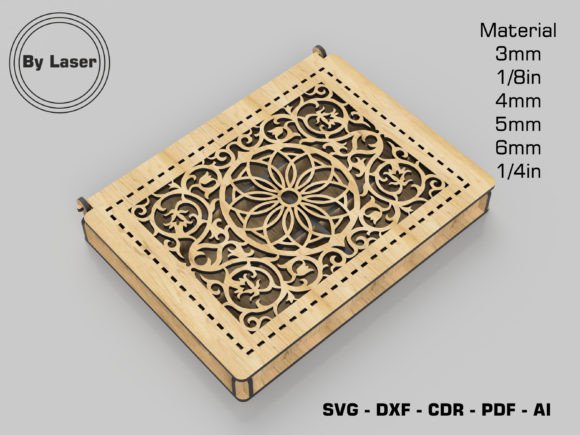
When you purchase a Wooden Decorative Boxes LaserCut Bundle, you are acquiring a compressed zip folder containing ten unique designs. These are not images in the traditional sense; they are vector and raster files engineered for precision manufacturing. The bundle typically includes files in six distinct formats: SVG, DXF, EPS, PDF, JPG, and PNG.
Each format serves a specific purpose in the workflow of a maker:
- SVG (Scalable Vector Graphics): The gold standard for web-based cutting software like Cricut Design Space or Silhouette Studio. It ensures lines remain crisp regardless of scaling.
- DXF (Drawing Exchange Format): Widely used in professional CAD (Computer-Aided Design) programs and industrial laser cutters like Glowforge or Epilog.
- EPS (Encapsulated PostScript): Preferred by graphic designers using Adobe Illustrator for high-end editing and print preparation.
- PDF: A universal format useful for viewing dimensions and sending to print shops that accept vector data.
- JPG and PNG: Raster image formats included primarily for inspiration, mockups, social media promotion, or sublimation printing.
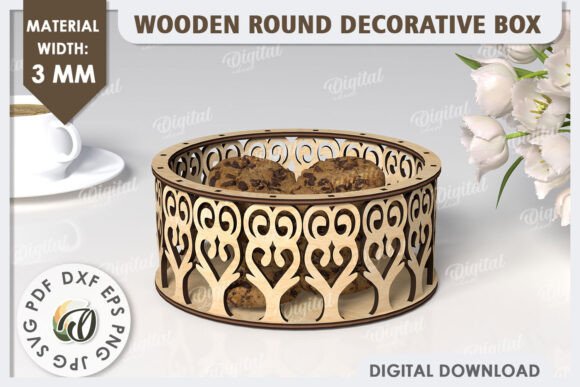
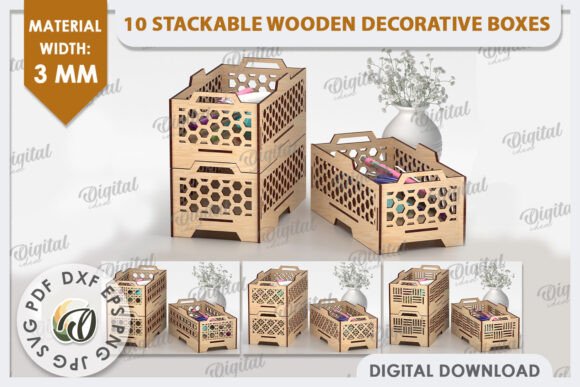
The photos displayed in the shop listing are for inspiration purposes only. They demonstrate what is possible when the digital file meets the physical material. Your purchase empowers you to replicate these results, modify them, or use them as a foundation for entirely new creations.
The Significance of Material Specifications
A critical component of successful laser cutting is understanding material constraints. For this specific bundle, the designs are optimized for a material width of 3mm. This specification is not arbitrary; it is the result of precise engineering regarding kerf (the width of the cut made by the laser) and joint tolerance.
Laser cutters remove a tiny amount of material as they burn through wood. If a design is drafted for 3mm plywood but you attempt to use 4mm MDF without adjusting the file, the tabs and slots will not fit together. The pieces may be too loose, causing the box to collapse, or too tight, risking cracks in the material. By adhering to the 3mm requirement, users ensure that the intricate finger joints and decorative elements align perfectly, resulting in a sturdy and aesthetically pleasing final product.
Bridging the Gap Between Digital Files and Physical Reality
The concept of buying a "nothing" product—a file rather than an object—can be confusing for beginners. However, in the context of modern fabrication, the file is often more valuable than the finished good. Why? Because the file offers scalability and repeatability.
Imagine you are a small business owner selling handmade jewelry. You need packaging that reflects your brand's elegance. Buying ten pre-made wooden boxes might cost a fortune and limit your color choices. By purchasing a digital bundle, you can cut fifty boxes from birch plywood, stain them a custom shade, and engrave your logo directly onto the lid before assembly. The digital file becomes a reusable asset that pays for itself after the first few uses.
Versatility Beyond Woodworking
While the primary application of this bundle is creating wooden home decor, the versatility of vector files extends far beyond the workshop. The prompt notes that these designs can be utilized for stationery, textile, tableware, prints of fashionable clothes, paper, and packaging. Here is how these diverse applications work in practice:
- Paper Crafts and Stationery: By scaling the design down and using heavy cardstock, these box templates become exquisite gift boxes for weddings or luxury retail packaging.
- Textile and Fashion: The SVG or EPS files can be imported into embroidery software to stitch the decorative patterns onto denim jackets or tote bags. Alternatively, the patterns can be used as stencils for fabric painting.
- Sublimation Printing: Using the included PNG or JPG files, creators can print the decorative patterns onto sublimation paper and transfer them onto mugs, coasters, or polyester fabrics, effectively turning the box design into a surface pattern.
- 3D Printing: Advanced makers can import the DXF files into 3D modeling software to extrude the shapes, creating plastic versions of the wooden boxes.
This cross-disciplinary utility highlights the true power of digital assets. You are not just buying a box template; you are buying a design element that can be integrated into almost any creative medium.
Common Misunderstandings and How to Avoid Them
Despite the clear benefits, there are common pitfalls for first-time buyers of digital laser cut files. Addressing these upfront ensures a smoother experience and better results.
Misconception 1: "The file will automatically work on any machine."
While SVG and DXF are universal, every laser cutter has different settings for power, speed, and frequency. Users must perform test cuts on their specific machine to determine the optimal settings for their chosen 3mm material. The file provides the shape, but the operator provides the technique.
Misconception 2: "I can change the material thickness easily."
As mentioned earlier, parametric changes to material thickness require advanced CAD skills. For most hobbyists, it is safest to stick to the recommended 3mm specification unless they know how to offset paths and adjust joint widths manually.
Misconception 3: "Photos show the exact color I will get."
Since no physical product is sent, the color of the final item depends entirely on the user. Whether you choose natural bamboo, stained walnut, or painted acrylic, the outcome is in your hands. This is a feature, not a bug, allowing for total customization.
The Role of Community and Support
Navigating the world of digital fabrication can sometimes feel isolating, but the creator community is robust and supportive. Most sellers of these bundles encourage communication. As noted in the product description, "Please write me a message if you have a question." This open line of communication is vital.
Questions might range from technical issues ("My lines aren't connecting in Illustrator") to creative advice ("What finish do you recommend for birch ply?"). Engaging with the seller not only solves immediate problems but also builds a relationship that can lead to future collaborations or access to exclusive updates. It transforms a simple transaction into an educational partnership.
Integrating Laser Cutting into Modern Life and Business
The accessibility of tools like desktop laser cutters has democratized manufacturing. What once required a factory floor can now be done on a kitchen table or in a garage studio. Digital bundles like the Wooden Decorative Boxes LaserCut Bundle are the fuel for this micro-manufacturing revolution.
For educators, these files offer a tangible way to teach geometry, engineering, and design thinking. Students can assemble the boxes to understand spatial reasoning and the properties of materials. For entrepreneurs, they lower the barrier to entry for launching a product line. Instead of investing thousands in inventory, a creator invests a small amount in digital designs and raw materials, producing goods on demand.
Furthermore, the sustainability aspect cannot be overlooked. Digital products have zero shipping carbon footprint. By sourcing local wood and cutting only what is needed, makers reduce waste compared to mass-produced, globally shipped items. The ability to repair or reproduce a broken part simply by running the file again promotes a culture of longevity over disposability.
Conclusion: The Endless Horizon of Creation
The purchase of a digital laser cut bundle is an investment in potential. It represents a shift from being a passive consumer of goods to an active creator of solutions. With ten diverse designs ready to be cut, engraved, and assembled, the options are truly endless. Whether you are decorating your home, launching a boutique brand, teaching a class, or simply exploring the joys of making, these files provide the structural foundation upon which your imagination can build.
Remember, the journey begins not with a package delivery, but with a download. Unzip the folder, select your 3mm material, calibrate your machine, and let the laser do the rest. The fusion of digital precision and tactile craftsmanship is where the magic happens, and with the right tools and knowledge, there is no limit to what you can create.
Enjoy the process, experiment boldly, and remember that help is always just a message away should you need guidance on your creative journey.